About Me
Hello, I'm Moinul Islam. I am a Senior Software QA Engineer with five years of professional experience in software quality engineering, test automation, and framework development. My work increasingly focuses on agentic AI, autonomous testing pipelines, and AI-assisted software engineering. I also have an academic research background in machine learning and deep learning, with a publication in Neural Processing Letters on brain tumor classification using federated learning and CNN ensembles. I am passionate about exploring emerging technologies, solving real-world challenges, and pursuing research at the intersection of artificial intelligence and software engineering. [Online CV]
Experience
Senior Software QA Engineer at Enosis Solutions
November 2023 – Present• Developed agentic AI workflows and testing pipelines, coordinating 2 agents across 3 virtual machines to test 2 application builds.
• Design, develop, and maintain test automation frameworks for web and desktop applications.
• Define automation strategies, test approaches, and implementation plans aligned with project requirements.
• Conduct R&D on automation tools, emerging technologies, and AI-assisted testing solutions to improve QA efficiency.
• Lead QA initiatives, review team deliverables, and mentor 5 team members to maintain quality standards.
• Collaborate with onshore and offshore teams, developers, and stakeholders to ensure effective delivery.
Software QA Engineer at Enosis Solutions
November 2021 – October 2023• Developed test automation scripts using Cypress.
• Created and maintained automated CI/CD pipelines to support code deployment.
• Prepared checklists, test cases, test plans, and test reports.
• Performed cross-browser and exploratory testing.
• Conducted functional, regression, integration, and non-functional testing for web and mobile applications.
Research Assistant at Multimedia Signal & Image Processing Research Group
January 2021 – September 2021• Worked under the supervision of Dr. Jia Uddin of Woosong University.
• Research areas: deep learning, image processing, and fault signal detection.
• Contributed to research experimentation, implementation, and preparation of journal manuscripts.
Undergraduate Teaching Assistant at BRAC University Dept. of CSE
September 2019 – September 2020• Course taught: Digital Logic Design.
• Held consultation hours for students and checked and graded assignments.
• Conducted lab classes alongside faculty and worked with my supervisor to develop teaching strategies.
Education
Bachelor of Science in Computer Science and Engineering at BRAC University
May 2016 – October 2020• CGPA: 3.75+ (out of 4).
• Graduated with high distinction.
Publication
Federated Learning and CNN Ensemble Architectures for Identifying Brain Tumors
August 2022• Authors: Moinul Islam, Md Tanzim Reza, Mohammed Kaosar, and Mohammad Zavid Parvez
• Journal: Neural Processing Letters, 55, 3779–3809 (2023). DOI: 10.1007/s11063-022-11014-1
Projects
Brain Tumor Classification Using CNN Ensembles and Federated Learning
July 2020 – October 2020• Evaluated six pretrained CNN architectures for brain tumor classification using MRI images converted from 3D NIfTI volumes to 2D images. Developed average and voting ensemble classifiers using the three best-performing architectures and implemented a federated learning approach with local client training and centralized model aggregation. Evaluated model performance using accuracy, sensitivity, specificity, AUC, and Dice similarity coefficient (DSC).
Agentic AI Desktop Test Automation
August 2026 – Present• Deployed and configured the containerized automation environment, including AI agents, ASD Runner, Monitor, and Snippet Factory, supporting AI-assisted desktop test generation, execution, and review. Developed and validated C#/FlaUI golden scripts using semantic UI locators, contributing reusable automation workflows, controls, and snippets to the pipeline’s test catalog. Worked with the pipeline’s RAG-based retrieval workflow, including embedding-based semantic search and PostgreSQL/pgvector storage, to support AI agents in retrieving validated automation knowledge.
Multi-Agent Cross-Build Test Automation Framework
December 2025 – Present• Developed a Page Object Model (POM)-based framework to dynamically discover report filters and options, automate desktop workflows, and export test results across baseline and candidate application builds. Implemented distributed execution across dedicated Azure Virtual Desktop machines using remote agents, heartbeat monitoring, JSON job queues, immutable test packages, and shared result storage.
COVID-19 Detection from Chest X-Ray Images Using Deep CNNs
January 2021 – March 2021• Developed a custom CNN and a transfer learning-based model using DenseNet121 to classify COVID-19 cases from chest X-ray images. Compared model performance using test accuracy, achieving 96.93% and 97.43% accuracy, respectively.
Industrial Fault Diagnosis Using the Hilbert Transform and CNN-LSTM
March 2021 – April 2021• Processed normal motor-bearing signals and three types of fault signals. Applied the Hilbert transform and converted the resulting signals into 2D images. Trained and tested a CNN-LSTM model to identify fault signals.
Relevant Coursework
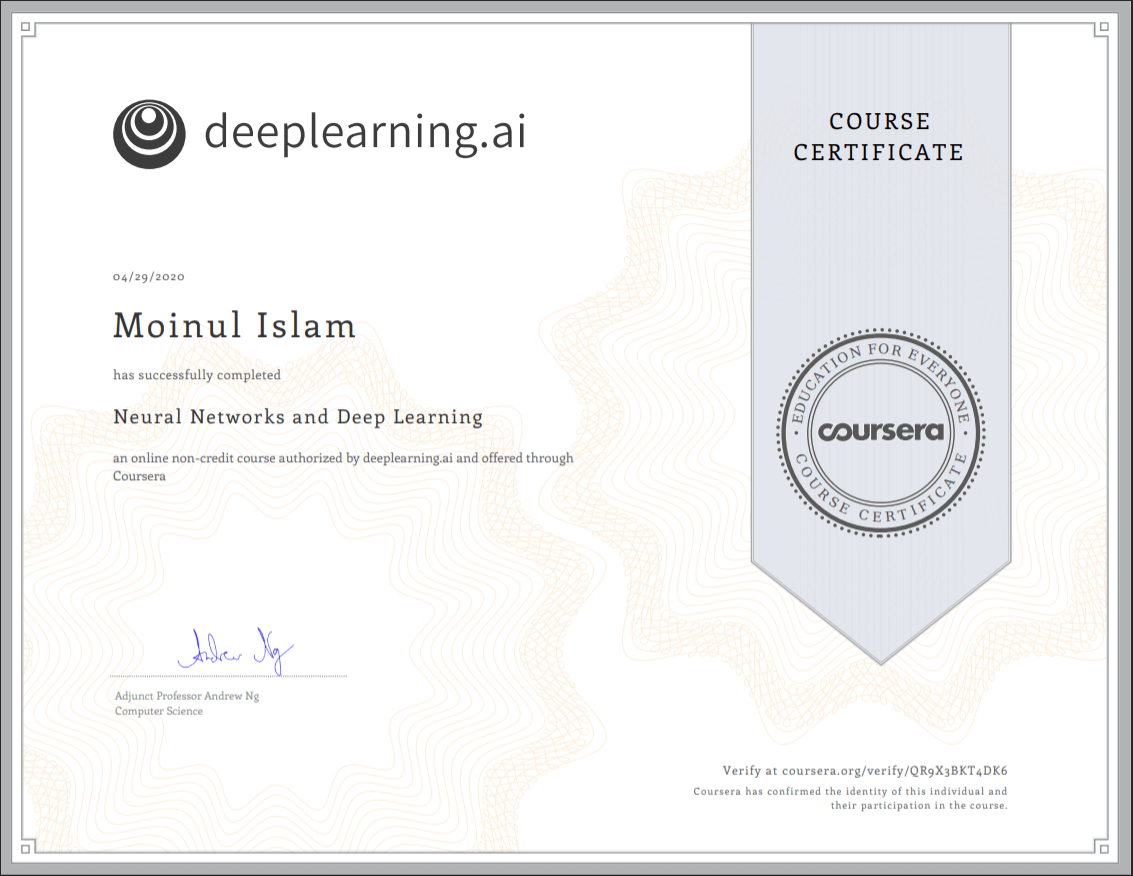
Neural Networks and Deep Learning
Coursera• Gradient Descent
• Logistic Regression
• Activation Functions
• Neural Networks with Hidden Layers
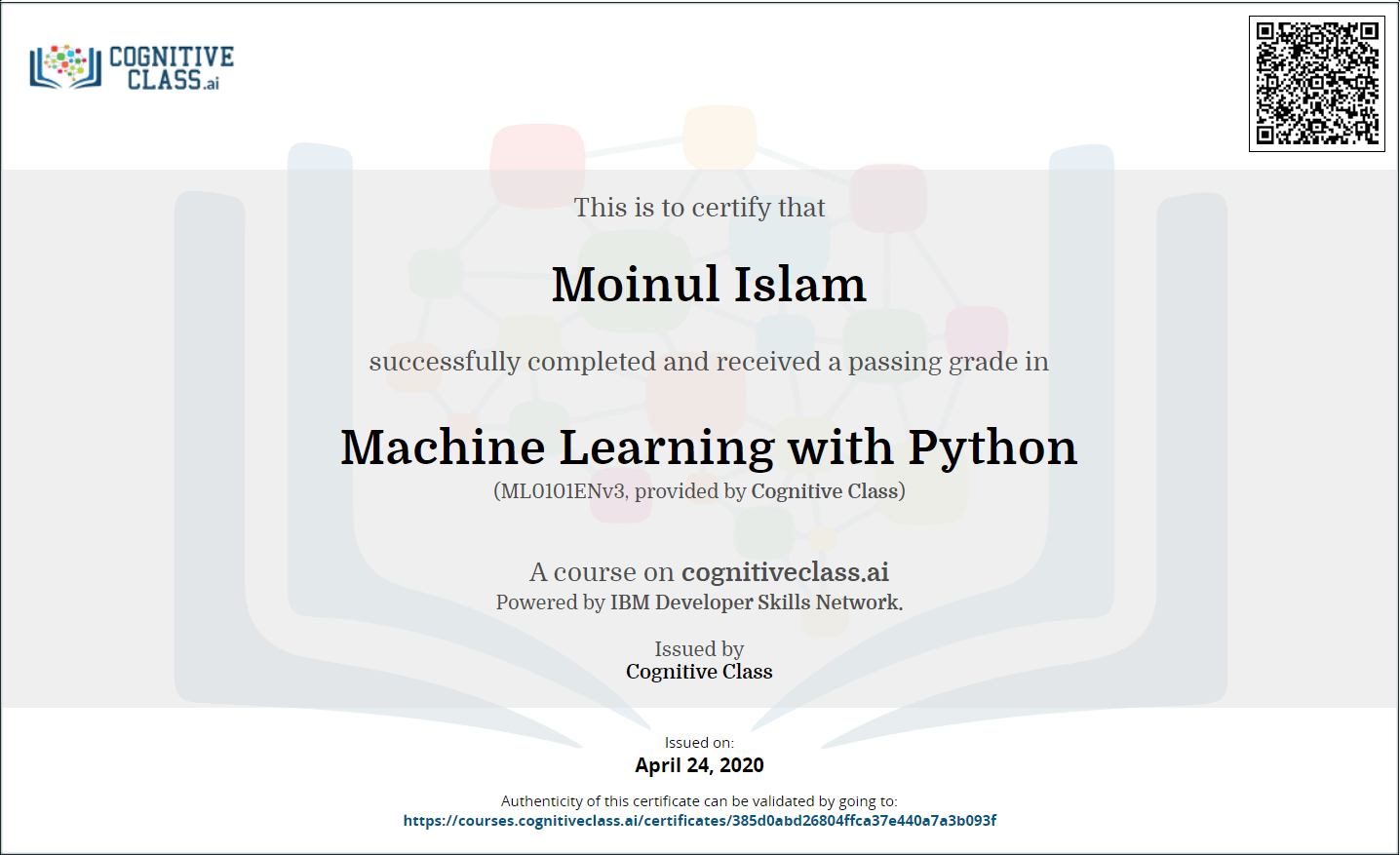
Machine Learning with Python
Cognitive Class• Support Vector Machine (SVM)
• Decision Trees
• Introduction to Recommender Systems
• K-Nearest Neighbors
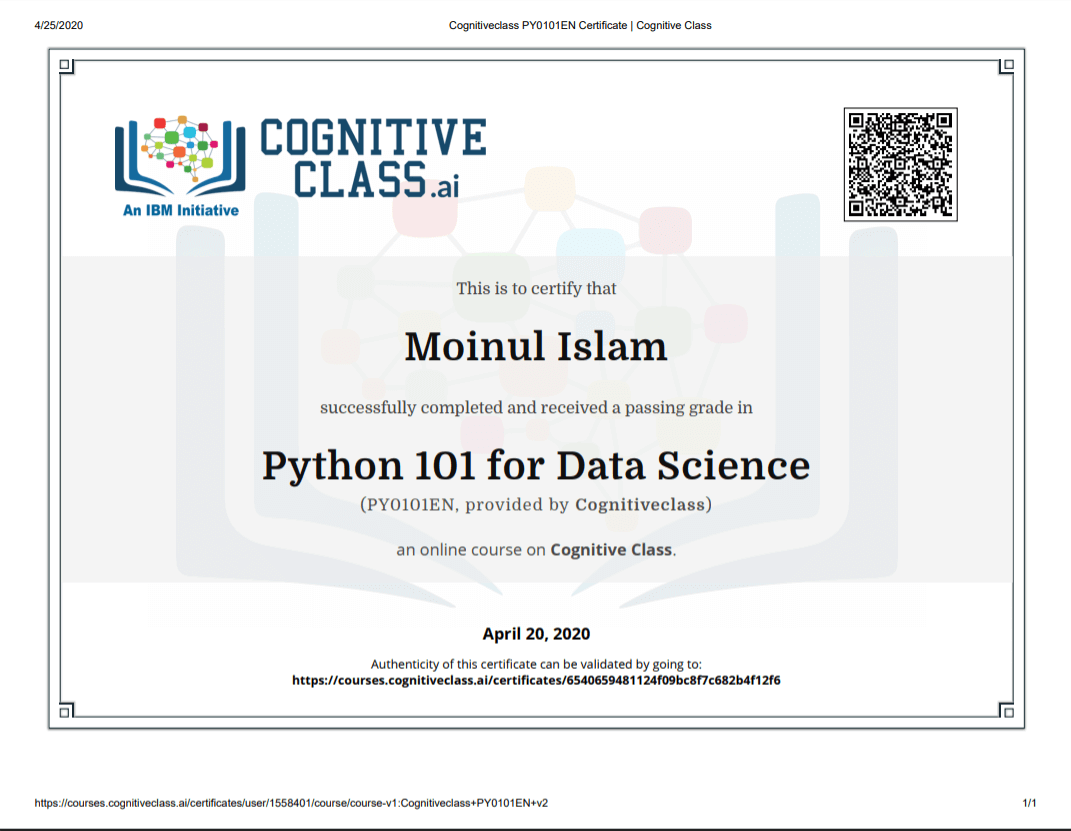
Python for Data Science
Cognitive Class• Working with Pandas
• NumPy 2D Arrays
• Expressions and Variables
• Lists, Tuples, and Functions
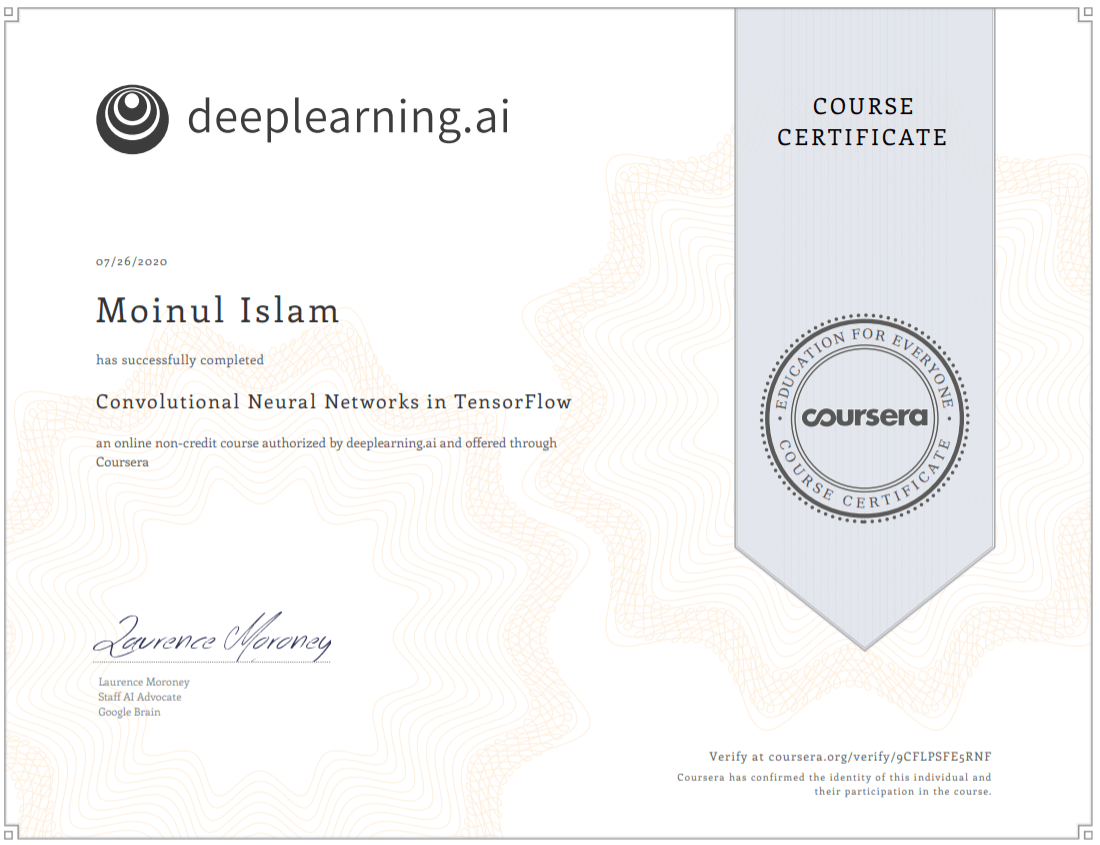
CNN in TensorFlow
Coursera• Transfer Learning
• Image Augmentation
• Multiclass Classification
• Dropout Layer
Volunteer Experience
Student Mentor at BRAC University
May 2019 – September 2020• Guided new students to resources and opportunities available on campus.
• Served as a point of contact for students and regularly monitored their performance.
Intern at Institute of Wellbeing
September 2017• Organized a seminar and a fair at BRAC University’s Savar campus.
• Prepared a proposal on car-free cities, healthy canteens, and parking.
Extracurricular Activities
Graphic Design
April 2020
• Adobe Illustrator |
Certificate
• Canva
Book Reading Competition at the British Council
April 2016• Through BRAC University | Certificate
Animated Filmmaking
January 2017 – April 2017• BRACU RS activity | Certificate
Content Creation
July 2022Programming Skills
Language Skills
1. Bengali (Native)
2. English (Full professional proficiency)
3. French (Elementary proficiency)
4. Chinese (Elementary proficiency)
Other Skills
Libraries & frameworks: Cypress, Selenium, TensorFlow, Keras, Pandas, Bootstrap, Django.
Development tools: Git, Sourcetree, Postman, Sauce Labs, ClickUp, Jira, Azure DevOps, MySQL Workbench, VS Code, LaTeX.
Fields of interest: artificial intelligence, machine learning, deep learning, large language models (LLMs), and software engineering.
AI & autonomous systems: agentic AI, AI-assisted testing, RAG, and vector databases.
Awards
Academic Distinction: Graduated with high distinction.
Vice Chancellor's List: Recognized five times for achieving a semester GPA above 3.90.
Dean's List: Recognized for academic achievement.
BRACU Performance-Based Scholarship: Awarded based on CGPA ranking.